


I'm sure you're familiar, but let's do a quick review for those not familiar with the math...Ok I'll bite, since I've learned you never say something without substantiation.
Is it not possible to get sufficient clamp load on a JK spacer due to the size/material of the lugs? Or is it there not enough structure to support and transmit the load to/from the wheel? I haven't run the threaded fastener equations to understand them at that level. If so, then I'll modify my response in future posts. Always happy to learn!
FYI - My experience is different then yours. A career in engine design where we commonly traded continuous material for an extra highly stressed bolted joint for various reasons. 1st hand motorsport involvement where I've seen more failed crappy wheels and can't recall seeing a spacer-related failure. However, I'm new to the Jeep world so my knowledge is more theoretical, not practical, based on where the limitations are on a JK.

When, T = F x d (I'll stick with simple letters here instead of Greek in case some browsers don't display properly)
Where:
T = torque
F = force from weight/impact/movement
d = distance
Take a simple example here: say a tire experiences a 2000 lb equivalent load going over a bump. Let's say that the wheel offset is 3", which would make this moment come out to 6000 lb-in (2000 x 3). Now do the same math, but add a 1.5" spacer into the equation, and you're now at 9000 lb-in, or a 50% increase in bending movement.
It is important to note here that the above applies to both spacers, as well as wheels with the same total offset... from a mechanical standpoint, a spacer is equivalent to a wheel with more offset. The problem is that although the moment arm calculations between the two (spacers vs larger offset wheels) is mathematically identical, this is not the only factor at hand.
Other factors that affect reliability are:
- Spacers are often made of aluminum and are prone to thermal expansion differences (aluminum generally being ~2x that of steel). While this isn't a catastrophic issue by itself, it will affect clamp loading over time, especially during heavy and repeated braking.
- Tiny, microscopic movements between the hub-spacer and spacer-wheel can lead to interface fretting. With 2x the clamping surfaces, this conceivably can occur twice as much, and in locations where salt, naturally acidic rain, shock loading, etc. can occur, this can add up
- Tolerance stacking is another issue here. With the addition of a spacer, you have additional runout potential, concentricity errors, and tolerance accumulation. Even barely measurable differences can add up and create micro vibrations, imbalances, and cyclic loading. While good quality spacers lower this, it's just a numbers game when you start adding more components.
- Spacer rigidity - where we previously just had one set of studs, with spacers there are now two stud sets and two torque interfaces which can cause the spacer to flex ever-so-slightly under load. This is of course exacerbated with larger tires, heavier weight, high side loads, etc. Even billet spacers are not infinitely rigid and under heavy lateral loads, there is some measurable elastic deflection. Repeated over thousands of miles, the repeated flexing can cause fatigue and eventually fail (aerospace learned about this the hard way many times, including unfortunately very recently)
- Separate from #2 above, galvanic issues can also cause issues outside of preload loss and fatigue, though these are generally manageable "seasonally"
- Related to #4, the JKU uses 1/2" wheel studs. While these will indeed provide sufficient clamp load in a static situation, with thermal expansion differences and enough spacer flex, a 1/2"-20 stud can start to experience shear forces instead of just tension loads.
Unlike in your example where a bolted joint has advantages and itself becomes an engineered structure, wheel spacers add complexity, interfaces, tolerance stack-up, and additional opportunities for failure. While I certainly don't think they're the death sentence that some people on the internet pretend that they are even top quality spacers still have some inherent issues about them that would prevent me from empirically saying "only the cheap ones are problematic". Anecdotally, I've seen too many failures (not 100's or even a dozen, but enough to stick in my head) from people that would otherwise be considered excellent fabricators and/or anal-retentive folk (like myself!) to say that they are simply "maintenance related issues".
Are the "bad"? Certainly not. Would I use spacers? I can't imagine a situation where I would (at least not long-term)


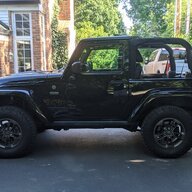
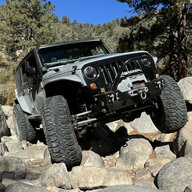
 . The reason for the extra offset (best I cal tell) is for steering clearance. Imagine a set of high end raceline wheels mounted on teraflex 60’s with spacers. I use it hard enough (abuse??) to probably justify getting the correct offset wheels.