

Novak Conversions Jeep Wrangler JK shifters

JK alternator headroom at idle

danmpls

New Member
Joined
Sep 7, 2024
Messages
8
Location
Midwest
Hello all - I'm hoping to build out a battery box for camping, and I'm stuck on selecting a charger.

I've picked up a 12V 165A LFP and plan to pair it with a DC-DC charger, charging it as quickly as possible to allow for multiday trips with limited solar. Pulling more power from the alternator would be ideal, and pulling meaningful power at idle would be a plus.

I've seen recommendations for a charger around 50A (e.g. Victron Orion XS), but I'm struggling to characterize the performance I'd see at idle. Can anyone weigh in on the following?
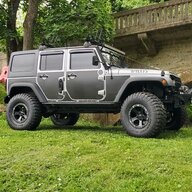
  • The 2017 JK alternator looks to be rated at 160A. I'm assuming a 50 or 60A charger would do fine while driving?
  • For a stock JK, what current can a DC-DC charger pull at idle with accessories all on or all off? I'd bet that there's significant headroom, but how to find the limit?
  • Do DC-DC chargers step down gracefully from their rated output, e.g. if a 50A charger is seeing 30A at idle, will it drop the output or cut off entirely?
Thanks for any help you can provide.
 
I have a couple of thoughts/questions.

1. Years ago when I was into big speakers, big amplifiers, and dual battery setups, I used to install a smaller pully on my alternator to get more charging at idle instead of 2,200 RPMs.

2. Remember, depending on distance from OEM battery to DC-DC charger to your other battery will depend if you need 8 or 6 ga wires.

3. Are you running anything else with your DC-DC charger? Solar? Wind?

4. Your DC-DC charger should be a MPPT charger. This will regulate any spikes automatically. Also, if your output is lower than the 50A, it will automatically drop down to a safe amp rating.

5. A 160 amp alternator, you will see roughly +/- 40% at idle. So 64 amps and with everything on i.e. lights, radio, fan, etc. you'll see another loss of 30%. Now you're at +/- 19.2 amps at idle, 800 RPMs.

6. While driving and RPMs over 2,000, you can expect a 160 amp alternator to be at +/- 70 amps. Without adding extra strain to your alternator, I'd go with the 50A controller.

I hope this makes sense.
 
  • Like
Reactions: danmpls
I have a couple of thoughts/questions.

1. Years ago when I was into big speakers, big amplifiers, and dual battery setups, I used to install a smaller pully on my alternator to get more charging at idle instead of 2,200 RPMs.

2. Remember, depending on distance from OEM battery to DC-DC charger to your other battery will depend if you need 8 or 6 ga wires.

3. Are you running anything else with your DC-DC charger? Solar? Wind?

4. Your DC-DC charger should be a MPPT charger. This will regulate any spikes automatically. Also, if your output is lower than the 50A, it will automatically drop down to a safe amp rating.

5. A 160 amp alternator, you will see roughly +/- 40% at idle. So 64 amps and with everything on i.e. lights, radio, fan, etc. you'll see another loss of 30%. Now you're at +/- 19.2 amps at idle, 800 RPMs.

6. While driving and RPMs over 2,000, you can expect a 160 amp alternator to be at +/- 70 amps. Without adding extra strain to your alternator, I'd go with the 50A controller.

I hope this makes sense.

Thanks for the response.
  1. I'd heard of high idle kits, but don't know much about swapping pullies. I'll check into it.
  2. The charger will be in the engine bay, with the house battery in the rear. I think it should be straightforward to wire up, and I'll ensure the gauge matches the amperage and distance.
  3. Initially just the charger to the house battery, house battery powering laptop, starlink mini, ocasionally a small fridge or 12V heated blanket.
  4. I'll add solar later, but the battery box/enclosure will include those inputs and space for an MPPT controller. I figured better to have the DC-DC charger and MPPT controller separate for ease of troubleshooting/upgrading.
  5. Very helpful! This is the info I've been hunting for, and helps me estimate whether I can top up with idling and shorter drives.
  6. Makes sense, 50A seems like the right move.
Thanks again for the help.
 
  • Like
Reactions: JeepJeezy
Novak Conversions Jeep Wrangler JK shifters