How to Replace Clutch Slave Cylinder on a Jeep Wrangler JK

Chris

Administrator
Staff Member
Joined
Sep 28, 2015
Messages
32,552
Location
Gillette, WY
The slave cylinder moves the throw out bearing against the clutch pressure plate. This removes pressure from the clutch disc, keeping engine torque from traveling through the transmission. If the clutch disc was unable to depressurize, smooth shifting would not be possible. Brake fluid from the master cylinder reservoir travels through the hydraulic lines connected to the clutch master cylinder and slave cylinder. Brake fluid is not compressible, which allows the clutch pedals movement to act as a force against the rod in the slave cylinder.

Nov-19-Slave-Cylinder-118342.png


Materials Needed
  • Floor jack
  • Jack stands (x2)
  • 3/8" ratchet
  • 10mm-14mm sockets
  • Flat head screwdriver or pick
  • Rubber gloves
  • Safety glasses
  • Slave cylinder
  • DOT 3 brake fluid
Step 1 – Raise and support the front end
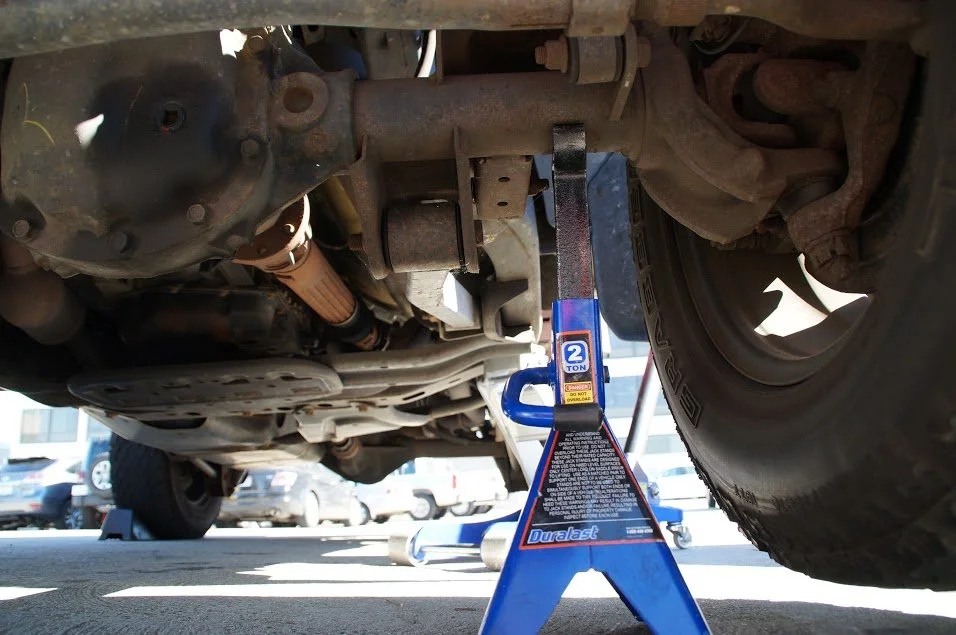
Engage your parking brake. Place your floor jack below one of the front jacking points and raise it until you can fit a jack stand beside it. Lower your Jeep's weight onto the jack stand and repeat the process for the other side.
DSC00072-118337.jpg

Figure 1. Jack up on the frame and put stands under the axle.

Step 2 – Remove mounting nuts from slave cylinder
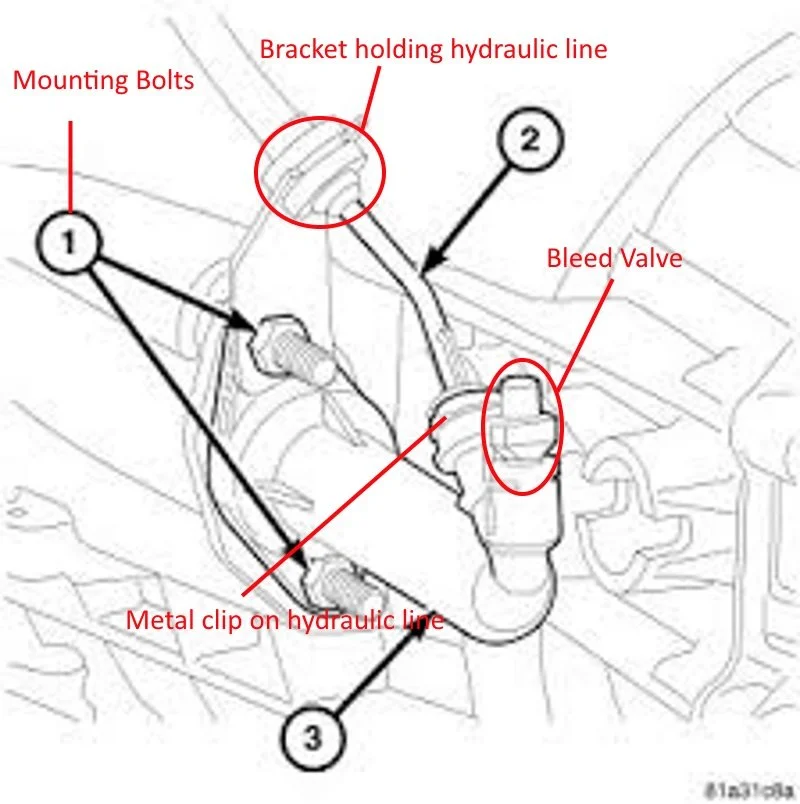
The slave cylinder is located on the driver's side of the transmission, near the front. Two mounting nuts hold it to the transmission.
wranglersalvecylinderdiagramcorrected-116673.jpg

Figure 2. A diagram of the slave cylinder.

Step 3 – Remove hydraulic line from slave cylinder
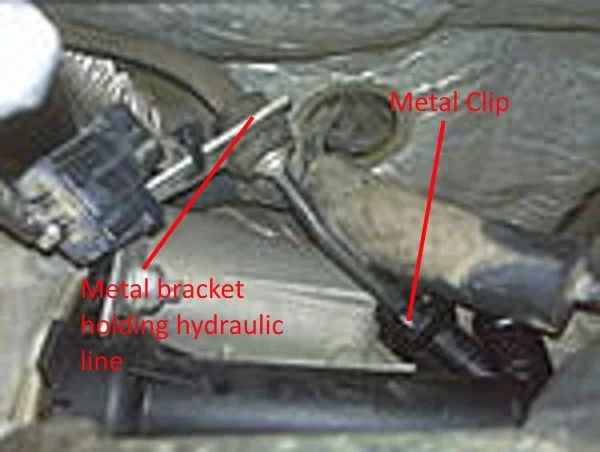
Use a pick or flat head screwdriver to move the metal clip to the unlocked position. Place your pick or screwdriver between the exposed portion of the clip and hydraulic line. Pull the metal clip away from the line until it clicks into the unlock position. Slide the hydraulic line out of the metal bracket. Remove the line from the slave cylinder with a pull/twist. There is a rubber O-ring at the bottom of this line. Make sure this O-ring is not damaged prior to install, otherwise the line will leak.
wranglerlineclipcorrect-116675.jpg

Figure 3. The hydraulic line bracket and clip.

Step 4 – Install new slave cylinder
Slide the slave cylinder onto the transmission studs, and then slide the hydraulic line bracket onto the top stud. Push the hydraulic line into the slave cylinder, making sure the rubber O-ring is installed. Begin tightening the mounting nuts, and then position the hydraulic line bracket upwards to connect the the line. Slide the line into the bracket and torque the mounting nuts to 17 ft/lbs.

Step 5 – Bleed slave cylinder
You will need a second person to bleed the slave cylinder. Fill the brake master cylinder fluid reservoir to the "max" level. You will see where it says min/max on the side. Use DOT 3 brake fluid. Remove the rubber dust cap from the bleed screw (see Figure 2). Turn the bleed screw half a turn while another person has the clutch pedal depressed. Make sure you're wearing rubber gloves and safety glasses. Brake fluid will come out of the screw at a high velocity. Once the pressure is gone (a couple seconds), close the screw and have the other person pump the clutch pedal about ten times. Repeat the bleeding process several times to achieve a responsive clutch pedal.
 
  • Like
Reactions: FirstLight
Chris,

I replaced my slave cylinder when I replaced my clutch, but it has leaked a little ever since, requiring additional fluid periodically. Now that the weather has turned cold, it is leaking more, and needs to be primed before it can be driven if it sits more than 24hrs. Can you point me to a parts break down. The o-ring looked worn when I replaced the slave cylinder, and I suspect that is the source of the leak. I just need to know that size to get, and can't find this information.

Thanks
 
Chris,

I replaced my slave cylinder when I replaced my clutch, but it has leaked a little ever since, requiring additional fluid periodically. Now that the weather has turned cold, it is leaking more, and needs to be primed before it can be driven if it sits more than 24hrs. Can you point me to a parts break down. The o-ring looked worn when I replaced the slave cylinder, and I suspect that is the source of the leak. I just need to know that size to get, and can't find this information.

Thanks


I just got done replacing mine also and the slave was leaking at the line, I found out that then line wasn't perfectly straight going into the slave. I loosened the nut where the bracket is that holds the line in a straight line so it looked straighter. Hasn't leaked since then, also I found out that you can't just buy the beveled seals. I lost the one from the slave and had to buy a new line just to get a seal.
 
Thanks Blackjku. I'll try that. If realigning it doesn't work, where did you get the replacement line?


https://www.amazon.com/dp/B00I6MTALY/?tag=jkforum-20, but any major parts store should have one.

Just a word to save you alot of time and cuss words, don't replace the line unless you absolutely have to. It's easier to take the inner fender cover out and go in from the side.

Also i'm finding the easiest way to bleed it is to jack the front up and pump the pedal until you feel it getting harder to push. Then let it sit for a while and come back and see if it's still firm like it was, if it isn't do it again. It's taken quite a few times but mine's getting there, I tried bleeding it at the bleeder but wasn't making much progress.
 
  • Like
Reactions: FirstLight
... Also i'm finding the easiest way to bleed it is to jack the front up and pump the pedal until you feel it getting harder to push. Then let it sit for a while and come back and see if it's still firm like it was, if it isn't do it again. It's taken quite a few times but mine's getting there, I tried bleeding it at the bleeder but wasn't making much progress.
Hi BLACKJKU,

I've been wrestling with this subject also and the techniques I learned are the opposite of yours. Here's why ...

Jack the Rear—not the Front—when you bleed the clutch
The factory instructions for bleeding the hydraulic brake conclude with the slave cylinder unmounted, but connected to the hydraulic line (see Step 4 on page 6-6 of Volume 1 of the factory Jeep Wrangler Service Manual). The mechanic points the slave cylinder downward so its actuator rod is pointing toward the ground. Then the mechanic opens the bleed valve, pushes the actuator rod in all the way to force out the that is normally trapped in the slave, then close the bleed valve before releasing the actuator rod.

Some DIY mechanics discovered a way to avoid this last step by elevating the rear wheels above the front. By jacking the rear of their JK/JKU up, it points the rod end of the slave downward in a similar fashion. When the rear is elevated like this, the clutch can be fully bled without removing the slave. I suspect that if you do it this way, you won't need to pump the clutch so much.

Beware sudden changes in temperature when bleeding
Also be aware that temperature can have a huge affect on this. I live in Michigan and when I first bled my clutch, it was cold (between 30-40°F) and the pedal was soft (the clutch plate didn't disengage until the pedal was nearly to the floor). Obviously there was still air in the system, but it was drive-able and I had to order more brake fluid before I could resume work on it. So I drove my Jeep a few times while I was waiting for more fluid to be delivered. Later that week a weather front hit and the temperature suddenly rose to 82ºF. Since the clutch hydraulic system is sealed, the air that was trapped in the system was pressurized by the temperature increase and the clutch felt better and disengaged a little earlier. This was deceptive because the air was still there and still needed to be removed—otherwise the clutch would become too soft again the next time the temperature drops. The moral is: Bleed your clutch fully under a steady temperature because a rise in ambient temperature can trick you into thinking the air is out when it really isn't—it's just under more pressure, masking the problem.

Use a bleed hose with the clutch the same as you would for the brakes
Here's another tip which should be obvious, but so many DIYer's seem to miss it: The nipple on the bleed valve of the clutch slave cylinder is designed for a bleed tube the same as the brake bleed valves. After you remove the protective cap from the clutch bleed valve, connect a silicone bleed hose with 1/4-inch I.D. and you can easily bleed the clutch with zero mess. It is insane to try to bleed the clutch without a bleed hose.

Caution: some after-market clutch slaves relocate the bleed valve to the side
Some third-party clutch slave cylinders relocate the bleed valve to the side instead of the top. It's my understanding that the Jeep engineers located the bleed valve on the top because air rises to the top and this is the best place for it. So I will stay with a Mopar part whenever I need to replace my slave cylinder. I'm not saying that a bleed valve on the side is worse—I honestly do not know—but, without more information, I prefer to trust Jeep.

Why did I bleed my clutch?
This is going to be a weird story because my clutch was working fine...

Here's the short version of the story: I was forced to remove the clutch master cylinder in order to replace the brake booster. And I had to add a separate clutch fluid reservoir because my new brake fluid reservoir did not support a hydraulic clutch. Opening the clutch hydraulic system allowed air to get inside. Hence the need to bleed my clutch.

Here are more details: I planned to upgrade the brakes on my 2010 JK Rubi next year (2027). But my brakes started to fail this year (2026). The pedal was getting soft and, when pushed firmly, could be forced to the floor (yet the brakes still seemed to function when it was pushed normally). Next, the parking brake started to fail (it would no longer hold on an incline and adjustments to it did not help). So I decided to start the brake upgrade this year.

I began by installing new PowerStop drum brake pads and a full hardware kit on the parking brake in each rear wheel. Then I installed a new heavy-duty PowerStop disc brake kit on all wheels (new rotors, calipers and pads). This was essential for the rear wheels because they use hybrid rotors with integrated drums for the parking brake and the drums were in very poor condition. I finished with a flush of the brake hydraulic system using new Amsoil DOT 3/4 synthetic brake fluid.

The parking brake now works like new and, after bedding the rotors with the new pads, the regular brakes work amazingly good. But ... the pedal still went slowly to the floor when it was pushed firmly. Since there are no visible leaks and the old fluid has been replaced with new, that points to a failing master cylinder. And, as many experienced JK/JKU mechanics know, a leaking brake master cylinder usually leaks into the booster, which accelerates its demise as well. But the cost of a new Mopar brake master cylinder and booster is crazy expensive (the discount prices at Mopar Parts Giant were $350 for the master cylinder and $470 for the booster).

Then I discovered Mopar's J8 upgrade kit that replaces the stock parts with the larger, more powerful military versions used on all military JKUs that were exported outside the U.S. (like Egypt). Mopar makes the J8 upgrade kit available to U.S. Jeep owners and it costs several hundred dollars less than the original parts. So it seemed like a no-brainer to choose the J8 parts over the stock parts. But there was just one problem: The J8 reservoir for its heavy-duty master cylinder does not include a chamber for a clutch. Evidently, the military JKU was only offered with an automatic transmission.

Replacing the brake booster usually requires it to be removed along with its mounting panel as a unit. And, since the clutch master cylinder also mounts to this same mounting panel, the clutch master cylinder must be removed first. I've done all this and have completed the installation—the brakes are awesome. They are better than new and I'm extremely happy with the Mopar J8 upgrade kit along with the PowerStop heavy-duty brake kit. After bench-bleeding the brake master cylinder and installing it, I did a full bleed of the brakes followed by three ABS bleeds followed by a final full bleed of the brakes.

For the clutch, I installed a Brembo 110.A263.85 clutch reservoir along with a mounting bracket of my own design. The new clutch reservoir is mounted above the clutch master cylinder and the flexible fluid line runs downhill all the way to the master cylinder to facilitate the required gravity feed. Everything looked great until I tried to bleed the air out of the clutch system. The clutch pedal was way too soft (remember, there was nothing wrong with my clutch before I started). I bled the clutch 15 times and could not restore normal operation. Apparently, my mistake was skipping the last step: I didn't remove the slave cylinder and do a final bleed by pushing its actuator rod while the slave is pointed downward (the rod pointed toward the ground) so air in the slave is pushed up and out the bleed valve. I had hoped that, since the slave and its hydraulic line were never removed, that I would not need to remove it during the bleed. I didn't realize that air would be pushed by the master cylinder to the slave and lodge there.

What to do? I didn't want to remove the slave unless I had to because I cannot see any good way to access the top mounting nut. Then I read about another JK owner who, facing the same dilemma, got around the problem by jacking his rear wheels as high off the ground as he could. That angled the slave in the required direction and enabled him to finish the clutch bleed by simply pressing on the pedal. So I followed his example.
 
Last edited: